
Dental clinic phone appointment booking guide

Fonify
Aug 12, 2026 · 6 min read
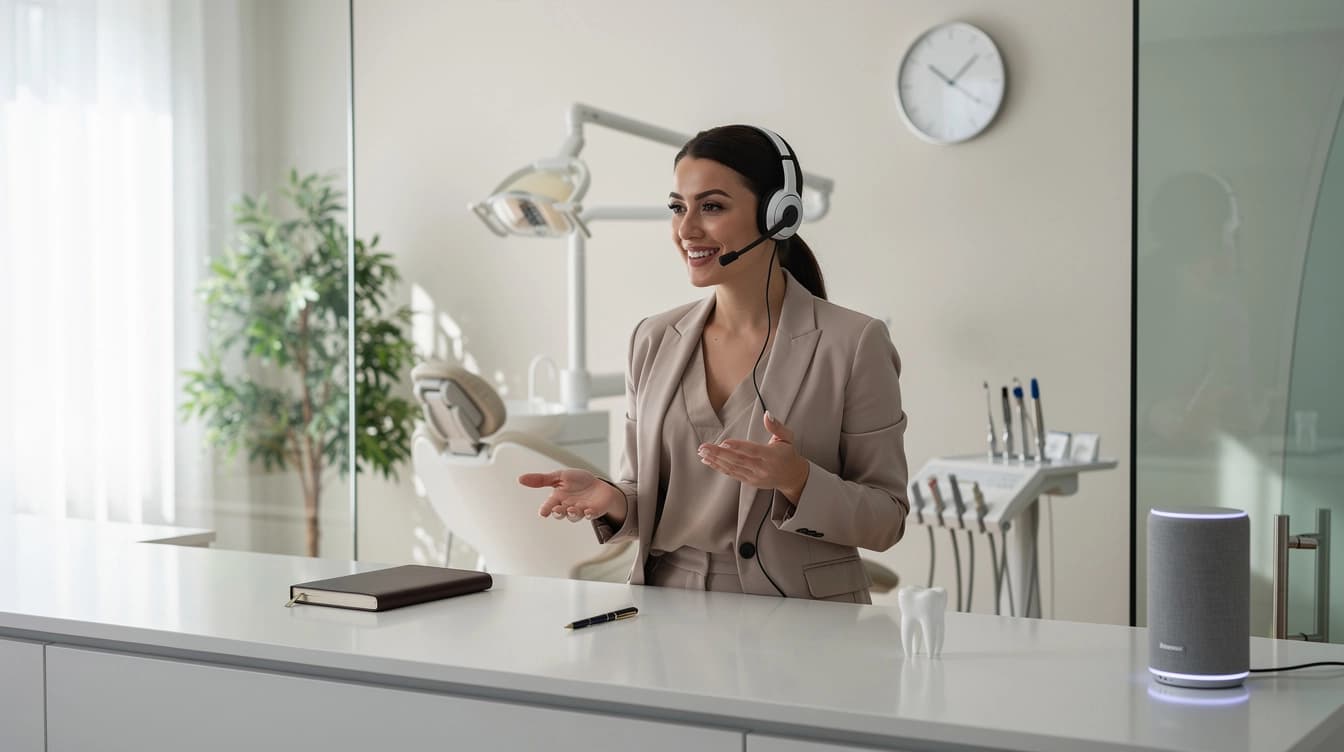
What is creating a phone appointment record for a dental clinic?
A dental clinic phone appointment record is created by capturing the caller's intent and availability through structured questions, then placing it into the correct calendar block based on doctor, unit, and duration constraints. Required fields are defined, data minimization is applied, conflicts are checked, and the record is securely sent to the clinic management system.
How do you ensure conversion from a phone call to the right calendar entry?
The foundation is a standardized flow, field validation, and calendar rules. In a sample call, Fonify’s voice AI employee follows these steps:
- Intent detection: New booking, reschedule, cancel, or information request.
- Identification and association: CRM lookup by full name and phone number. If an existing patient is found, update the record.
- Mandatory fields: New or existing patient, treatment heading or complaint, preferred time window, doctor preference.
- Slot search: Find the right resource and time based on treatment-specific block duration and required unit count.
- Conflict and rule checks: Double-booking prevention in doctor and unit calendars, lunch, sterilization, and break blocks.
- Confirmation and verification: Read back a summary. SMS and email confirmation, reminder plan.
- Transfer and record: Atomic write to the clinic management software, link to call record, generate a unique appointment ID.
This flow can be designed to align with the core fields of the HL7 FHIR Appointment resource model. Keep calendar objects consistent with RFC 5545 iCalendar concepts.
In the process of creating a phone appointment record for a dental clinic, which fields are mandatory, and which should not be requested?
Data minimization is essential per KVKK’s principle of being relevant, limited, and proportionate to the purpose. During the call, collect only what is necessary to create the appointment.
- Mandatory fields:
- Full name
- Phone number
- New or existing patient
- Treatment type or complaint title
- Preferred day and time window
- Preferred doctor or clinic location
- Nice-to-have fields:
- Notes and accessibility information
- Preferred communication channel
- Avoid requesting over the phone:
- National ID number
- Full address and billing details
- Credit card or payment data
- Detailed medical reports and test results
The table below summarizes the purpose of each field.
| Field | Purpose | Note |
|---|---|---|
| Full name | Identity matching | Fuzzy matching reduces errors |
| Phone number | Contact and deduplication | Can be prefilled via caller ID |
| New or existing patient | Determines flow and verification steps | Prefer light verification for existing patients |
| Treatment type or complaint | Block duration and unit planning | If unclear, ask triage questions |
| Preferred time window | Slot search and confirmation | Offer alternative windows |
| Doctor preference | Resource constraint | Keep a fallback doctor algorithm |
You can refer to KVKK Law art. 4, HL7 FHIR Appointment fields, and iCalendar standards.
How do you calculate block duration and unit needs by treatment type?
The clinic’s cost and patient experience are managed by allocating correct durations and resources. Start conservative and improve based on measurements.
Sample plan. The durations and unit counts below are illustrative. Update with your clinic data.
| Treatment type | Block duration (min) | Required units | Note |
|---|---|---|---|
| Exam and panoramic assessment | 20 | 1 | Sample estimate |
| Scaling and prophylaxis | 30 | 1 | Sample estimate |
| Single-surface composite filling | 45 | 1 | Sample estimate |
| Single-canal root canal treatment | 60 | 1 | Sample estimate |
| Implant planning consultation | 30 | 1 | Sample estimate |
| Implant surgery | 90 | 1 | Sample estimate |
It is common to add a 5 to 10 minute setup and sterilization buffer between blocks. This buffer provides flexibility for no-shows and delays. To reduce no-show rates, enable reminder and confirmation flows. For details, see How to reduce no-shows in a dental clinic?: https://fonify.co/tr/blog/dis-klinigi-no-show-azaltma
How do you prevent duplicate records and double bookings?
Conflicts typically arise for two reasons: multiple open records for the same patient, or two bookings at the same time on the same resource. To prevent them:
- Matching rules: Deduplicate using phone number plus a name-similarity threshold.
- Pre-check: Before creating a new record, search for open appointments within a 7-day window.
- Resource locking: Enforce single use per doctor, unit, and room. Use atomic writes for concurrent calls.
- Windowed confirmation: Offer alternative times and finalize selection to reduce leaks.
- Feedback loop: Conflict error codes and operator visibility.
The appointment reminder call guide explains confirmation and rescheduling steps in detail: https://fonify.co/tr/blog/dis-klinigi-randevu-hatirlatma-aramasi
How does transfer and integration to the clinic management software work?
Transfer must be error-free and traceable.
- Agreed schema: HL7 FHIR Appointment or the vendor schema. Map mandatory fields.
- Secure transport: Authorized API over HTTPS, with a retry queue on failure.
- Unique identity: Store a cross-application UUID. Reduces duplicate write risk.
- End-of-day reconciliation: Triple match of Call ID, Appointment ID, and Patient record ID.
- Update and cancel: Lifecycle aligned with iCalendar-like status fields.
This approach aligns with HL7 FHIR Appointment fields and RFC 5545 iCalendar rule sets.
Why is a voice AI appointment assistant advantageous on the phone?
- Consistent 24/7 greeting and triage.
- Standardized flow, field validation, and instant slot search.
- Unchanged enforcement of data minimization and security policies.
- Escalation: handoff to live staff for complex cases.
- Metrics generation: average call duration, first-call resolution, cancellation reason.
For a comprehensive evaluation, see our guide AI appointment assistant for dental clinics: https://fonify.co/tr/blog/dis-klinigi-icin-yapay-zeka-randevu-asistani
How should you approach the "How much does it cost" question and what are the cost items?
Exact figures depend on clinic volume and call distribution. The following is a sample calculation.
- Sample calculation:
- Monthly inbound calls: 2,000
- Average talk time: 2.5 minutes
- Total talk minutes: 5,000
- If line cost is x TL per minute, total line cost: 5,000 x TL
- AI license and integration: package fee y TL
- Estimated total monthly cost: 5,000 x + y TL
Cost items typically include line fees, software license, integration, quality assurance, and reporting components.
Which quality and compliance rules are critical?
- Data minimization and purpose limitation: KVKK art. 4 principles.
- Access control and logging: who updated which field and when.
- Standard field mapping: HL7 FHIR Appointment along with iCalendar alignment.
- Retention and disposal: delete or anonymize appointment data once the purpose is fulfilled.
- Auditability: end-of-day reconciliation reports and audit trail.
Relevant standards:
- KVKK Law: https://www.kvkk.gov.tr/Icerik/6649/6698-Sayili-Kanun
- FHIR Appointment: https://www.hl7.org/fhir/appointment.html
- iCalendar RFC 5545: https://datatracker.ietf.org/doc/html/rfc5545
Who is this not suitable for?
- Clinics that work entirely manually with paper calendars and keep no digital records.
- Organizations with highly variable treatment durations and no defined block-mapping rules.
- Locations where many patients refuse to share any personal information by phone.
- Clinics that never schedule outside standard hours and have no flexible slot plan.
Within these constraints, it is safest to first clarify process and data standards, then move to automation.
FAQ
- Which patient details should be mandatory when booking by phone?
- Only information limited to the appointment purpose should be collected. Full name, phone number for callback, new or existing patient status, requested treatment type or complaint, preferred time window, and doctor preference are sufficient. National ID or detailed medical history should not be requested unless necessary.
- How is appointment duration determined by treatment type?
- Durations should follow in-clinic standards. Treatment types are pre-mapped to block length and unit requirements. Create a sample estimate, then update with real measurements. Start with conservatively long blocks, then narrow averages as data accumulates.
- What should be done to prevent double bookings?
- Before adding any appointment, check for patient and time conflicts. Scan for recent open appointments with the same phone and similar name combination. Enforce single-resource use per doctor, unit, and room. For concurrent calls, atomic write and locking are essential.
- What is the secure way to transfer appointment data to clinic software?
- Transfer should be over HTTPS with an authenticated API. Follow HL7 FHIR Appointment or the vendor’s schema. Map mandatory fields, use a retry queue for failed writes, and reconcile calendars with call logs via end-of-day reports.
- How is data minimization applied during a phone call?
- Per KVKK, data must be relevant and proportionate to the purpose. Collect only what is needed for scheduling. Do not request medical reports, full address, national ID, or payment data over the phone. Prefer light verification for identity confirmation.
Sources
Stay informed about the future of communication
New features, industry playbooks, and real call examples in your inbox a few times a month.
Related Posts
 Night emergency call triage and on-call dentist routing for dental clinicsAI-based dental clinic triage for routing on-call dentists during night emergencies. 112 criteria, protocol template, cost calculation, and suitability limits.Aug 12, 2026
 Birthday greeting call guide for dental clinicsStrengthen loyalty with a dental clinic birthday greeting call. A practical guide for IYS consent, short call flow, opt-out, and cost planning.Aug 12, 2026
 How to reduce no-shows in a dental clinicA patient who does not turn up means an empty chair. A practical way to cut no-shows: a reminder rhythm, a real waiting list, and answering calls outside opening hours.Aug 12, 2026